From Shadowban to Courtroom: Jurisdiction under the Brussels Ibis Regulation in DSA Social Media Platform Disputes
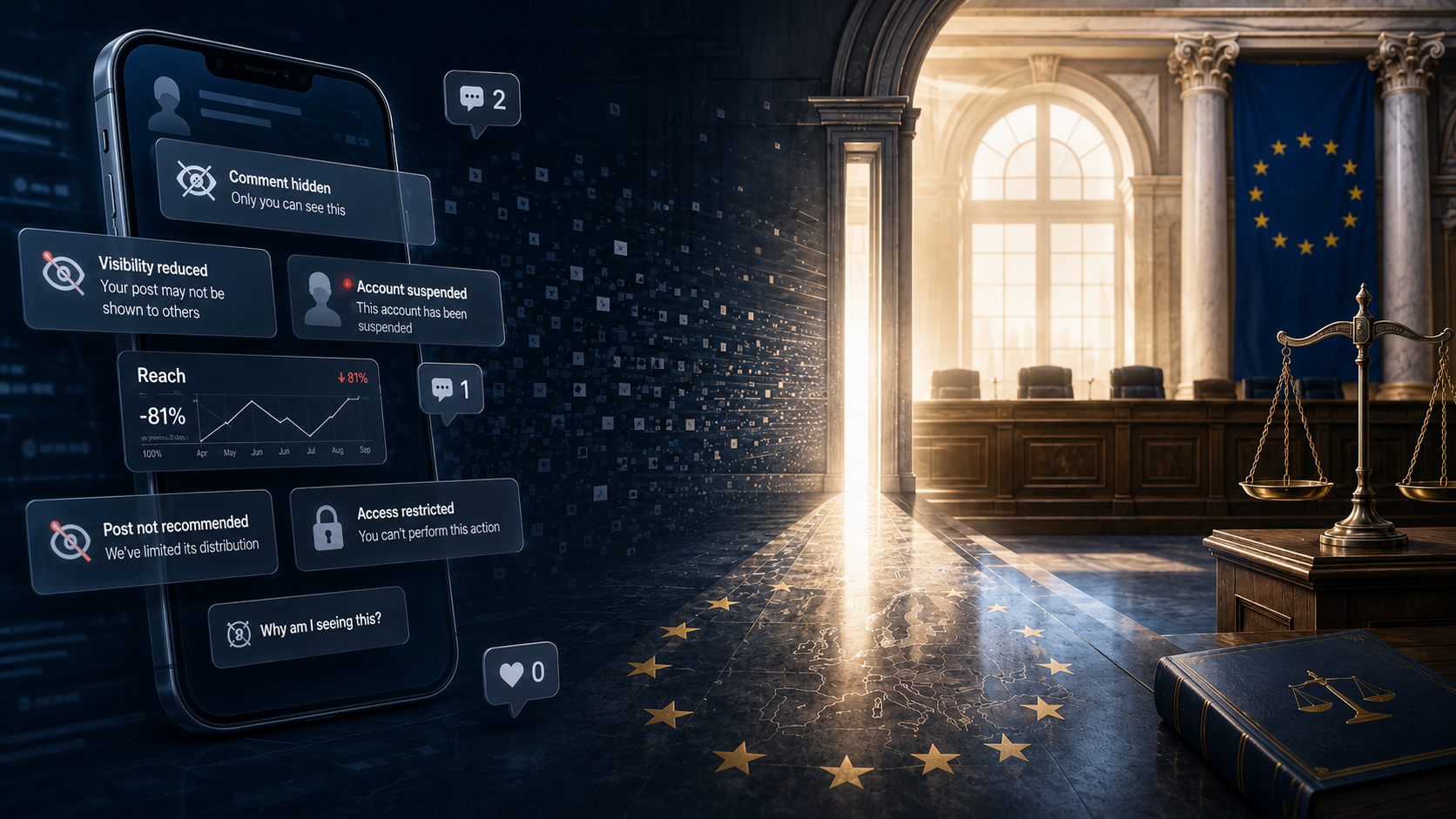
Image generated by Anastasis Kardamakis using Open AI’s ChatGPT, 19.6.2026
I. Introduction
Let us assume you reside (or your entity is incorporated) somewhere in the European Union; you wake up one glorious morning, sun shining and all, only to discover that Instagram, X or TikTok has suspended or restricted access to your account overnight.
Chills run down your spine; “this can’t be right”, you think.
The notification is rather brief: you allegedly breached the platform’s community standards, posted illegal content, or simply triggered an automated moderation system. Your posts are gone, your account is locked, your messages are inaccessible and, if you primarily use the account for visibility, activism, work or income (put simply, if you fall under the broad scope of the terms “influencer” and “content creator”), your digital life has effectively been switched off.
Your first thought is to pick up arms against the committed algorithmic injustice; as per the applicable Regulation (EU) 2022/2065, commonly known as the Digital Services Acts or DSA (in fact, all of the above referred social media moguls are classified as “very large online platforms” (VLOPs) thereunder), you exercise your right to challenge the decision taken by the provider of the online platform utilising its internal complaint-handling system (Article 20). Unfortunately, your submitted complaint is rejected (albeit in a reasoned manner) or simply goes unanswered. The platform firmly sticks to its prior decision.
Frustrated, your are left with three options: the first one revolves around accepting your inevitable fate and move on with your life, most probably by creating a new account or refraining from posting “red flagged” content in the future.
However, said option is not suitable for influencers, content creators or people who systematically post content deemed as problematic by the respective platform. In those cases, options two and three must be explored: one could resort to an out-of-court dispute settlement mechanism provided for under Article 21 of the DSA or pursue civil litigation, initiating proceedings against the platform and seeking interim or final relief. The further possibility or claiming damages cannot be overlooked.
This blogpost focuses on the latter scenario: a platform user residing or incorporated in Europe seeks the intervention of an E.U. member state court to reverse a restriction imposed by a social media platform, e.g., the suspension or termination of an account, the removal of content, demonetisation, or reduced visibility of posts. Such a litigious path raises a fundamental, two-fold question to be addressed at any preliminary stage of the proceedings: which court have jurisdiction to resolve the dispute between the user and the platform and how should it be determined?
II. The DSA redress structure and the application of the Brussels Ibis Regulation
As already briefly discussed above, the drafters of the DSA designed a dispute resolution mechanism with various internal and external elements, showcasing a regulatory design akin to the ones adopted by many modern national procedural regimes.
Article 17 requires providers of hosting services to give affected users a statement of reasons when they impose certain restrictions, including removal or disabling access to information, suspension or termination of service, suspension or termination of the user’s account, or restrictions on monetisation. For online platforms, Article 20 adds an internal complaint-handling system. Article 21 then provides for certified out-of-court dispute settlement bodies and mechanisms.
Although the DSA does not preclude users from initiating civil proceedings against the platforms, it does not contain any specific rules regarding the jurisdiction of national E.U. courts to hear the users’ claims (Pietro Ortolani, ‘The Resolution of Content Moderation Disputes under the Digital Services Act’ [2022] Giustizia Consensuale 533, 566 - 567. Regarding the interplay between the DSA and European PIL, see Michiel Poesen, ‘Connecting the Dots: The Digital Services Act (DSA) Seen Through the Lens of European Private International Law’ [2025] Revue de Droit Commercial Belge 689; Fabienne Jault-Seseke, ‘The Unspoken Aspects of European Digital Law in Private International Law: The Example of the Digital Services Act (dsa)’ [2025] Revue critique de droit international privé 61).
By way of comparative illustration, the GDPR does enshrine such a rule in Article 79(2) thereof. Hence, within the context of cross-border disputes pertaining to the application of the DSA, the question of jurisdiction is in principle governed by the Brussels Ibis Regulation (hereinafter, the “Regulation”). Indeed, where a dispute with an international element comes, inter alia, within the ratione materiae and ratione locis scope of the Regulation, the uniform rules of jurisdiction laid down therein must take precedence over national rules of jurisdiction (see, to that effect, Case C‑804/19 Markt24 GmbH [2021] available here, para 32).
The Regulation is the primary source to determine jurisdiction for both an interim measures application (Article 35) and the subsequent main action in a DSA-related dispute, seeking mosty injunctive relief (e.g. an order vis-à-vis the platform to restore content or access to an account).
The legal basis for said claims can be found directly in the provisions of the DSA or in a set of applicable national law rules, identified in accordance with the Rome I and Rome II Regulations (Lorenzo Gradoni and Pietro Ortolani, ‘Applicable Law in Out-of-Court Dispute Settlement: Three Vertigos under Article 21 of the DSA’ [DSA Observatory, 3 October 2025] <https://shorturl.at/j8q7O> accessed 18 June 2026; Tobias Lutzi, ‘The Scope of the Digital Services Act and Digital Markets Act: Thoughts on the Conflict of Laws’ [2023] Dalloz IP/IT, Forthcoming 1, 2 - 3, <https://ssrn.com/abstract=4367531> accessed 18 June 2026).
III. Can a DSA platform dispute be characterised as a consumer contract dispute within the meaning of the Regulation?
Disputes stemming from the application of the DSA and arising between the affected user and the platform are contractual in nature (Pietro Ortolani op. cit., 567). The user accepted the platform’s terms of service; the platform imposed a restriction under those terms; and the claimant argues that the restriction was unlawful, disproportionate, procedurally defective, or not justified by the contract.
If the claimant is a consumer, recourse is to be had to Articles 17–19 of the Regulation. Article 17 applies, broadly, where a consumer concludes a contract for a purpose outside their trade or profession with a trader who pursues or directs commercial activities to the Member State of the consumer’s domicile, and the contract falls within the scope of those activities (see in detail, Peter Mankowski, ‘Section 4 Jurisdiction over consumer contracts (Art. 17–Art. 19)’ in Ulrich Magnus and Peter Mankowski [eds], Brussels Ibis Regulation - Commentary [Verlag Dr. Otto Schmidt, 2022] 427 - 537).
On the one hand, large social media platforms plainly direct their services to users in multiple Member States. The fact that the platform service is “free” in monetary terms should not, in itself, prevent the existence of a consumer contract. The CJEU treated the private use of Facebook as capable of falling within consumer jurisdiction in the Schrems case (Cace C‑498/16 Maximilian Schrems v Facebook Ireland Limited [2018] available here, paras 34 - 41).
On the other hand, it should be examined ad hoc whether any particular claimant is acting as a consumer.
A purely personal social media account should usually qualify. A user does not lose consumer status merely because they are digitally sophisticated, publicly active, or legally knowledgeable. In Schrems, the Court held that Mr Schrems could remain a consumer in relation to his own Facebook account even though he had published books, given lectures, operated websites, collected donations and campaigned publicly on data protection issues (Cace C‑498/16 op. cit., paras 34 - 41).
But the answer may differ where the account in question is used to realise business or commercial goals. A TikTok influencer monetising content, a trader selling goods through Instagram, or a professional creator using social media platforms may struggle to rely on Articles 17–19 of the Regulation. For mixed-use accounts, the CJEU’s ruling in Gruber remains important: where a contract has both private and professional purposes, consumer jurisdiction is available only if the professional purpose is negligible (Case C-464/01 Johann Gruber v Bay Wa AG. [2005] ECR I-00439, paras 39 - 47). A personal account with occasional monetisation or content creation shall therefore be treated differently from a business-facing account built around sales, sponsorship or professional services.
Under Article 18 of the Regulation, the consumer may pursue legal action either in the courts of the Member State where the platform is domiciled or in the courts of the Member State where the consumer is domiciled. The platform, by contrast, may sue the consumer only in the courts of the consumer’s domicile. Restrictions to the conclusion of jurisdiction agreements also apply (Article 19).
That matters enormously in social media platform litigation. Most major platforms contract through entities established in the Republic of Ireland, chosen primarily for regulatory, organisational and tax reasons. Without the specific consumer jurisdiction rules, an ordinary user in Greece, Italy, Spain or Germany might face the practical burden of litigating abroad. By virtue of Article 18, the user may be able to turn their home courts into a legitimate forum actoris.
IV. Relying on the Forum Contractus
If the claimant is not a consumer, Article 7(1) of the Regulation becomes the natural starting point. It allows a defendant domiciled in a Member State to be sued, in matters relating to a contract, in the courts for the place of performance of the obligation in question. It should be noted, however, that said special jurisdiction can be invoked insofar as the respondent social media entity has a registered place of business within the E.U. pursuant to Articles 6(1) and 63 of the Regulation. The same is true for Article 7(2) examined under [V] herein.
As explained above, an action seeking reversal of measures adopted by a social media platform under the DSA will usually be a matter relating to a contract.
The difficulty is identifying the place of performance for a digital platform service, in light of the obligation which characterises the contract concerned (see, to that effect, Case C‑249/16 Saale Kareda v Stefan Benkö [2017] available here, para 40). Should that be the place where the platform’s EU entity is registered? Where the servers or operational teams are based? Where the user accesses and receives the service?
The CJEU recently held that “(g)iven that the obligation which characterises a contract for the online provision of software such as that at issue in the main proceedings consists in making that software available to the customer concerned, the place of performance of that contract must be regarded as being the place where that customer accesses that software, namely the place where he or she consults and uses it (Case C‑526/23 VariusSystems digital solutions GmbH v GR, owner of the undertaking B & G [2024] available here, para 22).
Although not a ruling concerning social media platforms, I believe that the CJEU’s reasoning could be applied by analogy to DSA disputes. Given that the characteristic obligation under a contract between the platform and its user is the former’s provision of access to the social-networking environment for the latter, the place where said user accesses the platform should be regarded as the place of performance within the meaning of Article 7(1) of the Regulation. That interpretation would also sit more comfortably with the DSA’s objective of making platform redress practically accessible.
Still, due to the lack of settled CJEU jurisprudence on the matter, an non-consumer claimant business should expect platforms to contest the place of performance.
V. What about the Forum Delicti?
Article 7(2) of the Regulation grants jurisdiction, in matters relating to tort, delict or quasi-delict, to the courts for the place where the harmful event occurred or may occur. Can a user of a social media platform rely on it instead of Article 7(1)?
The answer depends on how the claim is framed.
The CJEU has held that “matters relating to a contract” are ones “where the conduct complained of may be considered a breach of contract, which may be established by taking into account the purpose of the contract” (Case C‑548/12 Marc Brogsitter [2014] available here, para 24), whilst, on the other hand, “matters relating to tort, delict or quasi-delict” are “actions not based on a legal obligation freely consented to by one person towards another” (Case C-27/02 Petra Engler [2005] available here, para 51).
Moreover, in its landmark Wikingerhof judgement, the CJEU held that “where the applicant relies, in its application, on rules of liability in tort, delict or quasi-delict, namely breach of an obligation imposed by law, and where it does not appear indispensable to examine the content of the contract concluded with the defendant in order to assess whether the conduct of which the latter is accused is lawful or unlawful, since that obligation applies to the defendant independently of that contract, the cause of the action is a matter relating to tort, delict or quasi-delict within the meaning of point 2 of Article 7 of Regulation No 1215/2012" (Case C‑59/19 Wikingerhof GmbH & Co. KG v Booking. com BV [2020] available here, para 33).
By applying said reasoning to social media platform restrictions, Article 7(2) of the Regulation may be relevant where the user alleges a breach of statutory duties under the DSA, discrimination law, personality rights or other non-contractual obligations. For example, a claim that the platform failed to provide a statement of reasons, operated a moderation system contrary to DSA standards, or caused reputational damage through an unlawful restriction may indeed have a non-contractual dimension.
However, Article 7(2) should not be treated as an easy escape route. If the court cannot decide the claim without interpreting the platform’s terms of service, the matter is likely to be contractual. For instance, a request to “restore my account because I did not breach the Community Guidelines” will usually fall closer to Article 7(1) than Article 7(2).
Where Article 7(2) does apply, the CJEU’s online harm jurisprudence may become relevant. In internet personality-rights cases, the CJEU has held that jurisdiction can be established at the claimant’s centre of interests for the entirety of the damage, while also recognising more limited jurisdiction in Member States where online content is accessible for damage suffered there (see Joined Cases C-509/09 and C-161/10 eDate Advertising GmbH v X and Olivier Martinez v MGN [2009], available here, passim).
Yet an account suspension or restriction is not entirely identical to online defamation. The harm lies not in the content published online, but in exclusion from a digital service or restricted access thereto. Courts will therefore have to adapt Article 7(2) carefully to the social media platform disputes context.
VI. Choice of forum clauses in social media platforms terms of use
I do not know of any of the major “Big-Tech” players not relying on jurisdiction (or alternatively, arbitration) clauses contained in their terms of use compelling users to litigate before the courts of a particular member - state (usually, the Republic of Ireland) or a third state (more than often, the state or federal courts of California, U.S.).
In my opinion, claims arising from the application of the DSA, being contractual in nature, fall under the scope of such agreements. That is also true (in principle) for DSA related claims alleging infringement of a statutory provision (e.g. one contained in the DSA itself or national legislation pertaining to the protection of personality), if one relies on the CJEU’s ruling in the Hydrogen Peroxide SA case (Case C‑352/13 Damage Claims (CDC) Hydrogen Peroxide SA v Evonik Degussa GmbH and Others [2015] available here, paras 57 - 72).
The question left to national judges hearing claims of users against the platforms to decide is whether the choice of forum clauses in question have been validly concluded and are enforceable.
The relevant examination shall be based on Articles 25(4) and 19 of the Regulation if the claimant is considered a consumer, and Article 25 in conjunction with the lex fori prorogatum in cases where no consumer element can be discerned.
VII. Conclusion: the DSA opens the door, the Regulation points out the competent court
The DSA changes the procedural landscape of content moderation. Platforms must explain restrictions, offer internal complaint-handling and engage with certified out-of-court dispute settlement. But when those avenues are not used, are unavailable, or simply fail, national courts play a key role in the private enforcement of the DSA.
In a claim seeking reversal of an account suspension, content removal or relevant restrictions, the prime jurisdictional question is whether the user is a consumer. If they are, Articles 17–19 of the Regulation may allow them to initiate proceedings in their home member - state, save for Article 19. If they are not, Article 7(1) will often be the main normative point of departure, with Article 7(2) being available only where the claim truly rests on an independent non-contractual duty. Due regard must be give to dispute resolution clauses contained in the platform’s terms of use.
Being banned, suspended or restricted by a social media platform may feel like being kicked out of a private party. For content creators or influencers in could also entail significant financial loss. In EU procedural law, however, the next question is much less glamorous, yet far more important if out-of-court dispute resolution does not deliver: which court has jurisdiction to let you back in?
© 2026 [Anastasis Kardamakis]. All rights reserved.
This blogpost may be quoted and shared for non-commercial academic, educational, and research purposes, provided that appropriate attribution is given to the author and a link to the original publication is included. No part of this publication may be reproduced, distributed, or republished for commercial purposes without the author's prior written consent.
The content of this article is provided solely for informational and academic discussion purposes. It does not constitute legal advice, nor should it be relied upon as a substitute for professional legal counsel. The views expressed are those of the author alone and do not necessarily reflect the views of any institution, organisation, or client with which the author may be affiliated.